Episode Transcript
(Intro Music Starts)
SH: Hello everyone, I am Sam Hansen
SW: And I’m Sadie Witkowski.
SH: And you are listening to Carry the Two, a podcast from the Institute for Mathematical and Statistical Innovation aka IMSI.
SW: This is the podcast where Sam and I talk about the real world applications of mathematical and statistical research.
SW: Hey Sam, I’m excited to take another journey into the mathematics and statistics of gambling with you today
(Intro music ends)
SH: As I am with you, and let’s not forget about our guide David Taylor mathematician, Assistant Vice President at SUNY Erie, and author of the book Mathematics of Gambling and Games, an Introduction to Mathematics.
SW: Of course, I would never forget about our intrepid guide David. And where is David leading us today?
SH: To a land of bright lights, free drinks, overwhelming sound, and lost wages
SW: I can hear the strip calling! Casinos?
SH: Casinos!
DT: You can pull the lever, all those things. I mean, you feel like you have some control. And in a way, you have a little bit of control because one of the things that goes into your outcome is a random number. And typically, the random numbers that are used sometimes are based on what time is used. That's a seed. for a random number generator in most instances. So if you pull the handle now versus in a little bit, that could factor in.
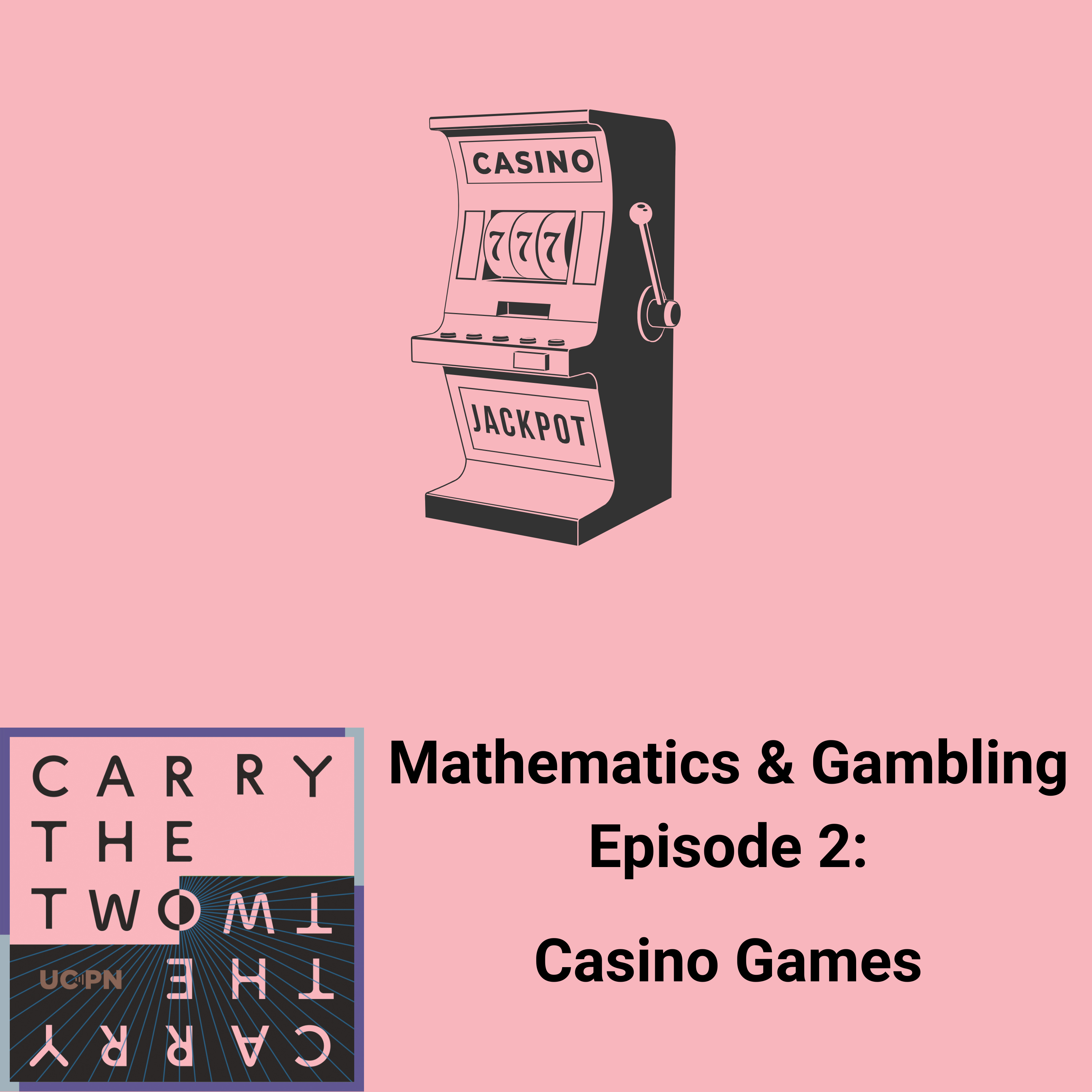
SH: David is of course speaking about the storied one armed bandit, the slot machine!
SW: Yeah, and starting right in there with some math this time aren’t we
SH: Ah yes, most slots these days are computerized which means that the final results you see on the screen are the results of code running in the background and one of the ways to make sure that code is not predictable, and no casino wants their games to be predictable, so the code has to be not predictable and that using some sort of random input, in this case the timing of the player pulling the arm or hitting a button, for that random seed
SW: Wow, so even before we start looking at the money, or expected value part that we focused so much on last episode, casinos are already using math?
SH: Well in the case of slot machines we are actually talking about the companies that create them not the casinos themselves. And those companies also care a lot about expected values, especially as they operate under oversight
DT: There are regulations, so that's another thing to look into is what the gaming corporations or the gaming control board in Nevada and other organizations keep in mind is, you know, usually if you say a machine is going to pay out 90% of what's wagered, it has to do that over a certain amount of time.
SH: Which is why David says…
DT: You know, all of these things factor in, which is probably why they want to hire mathematicians.
SW: Honestly, I read a horror novel where the premise focused on understanding randomness at a casino and the main character was a statistician. So I guess this isn’t so surprising
SH: Yeah, in fact I even interviewed with a gambling machine company before I decided to go down the mathematics podcast route
SW: Whoa, how do you feel about that choice?
SH: That I probably left some money on the table, ba dum tish. But I do much prefer to be talking about these machines instead of designing them. Especially given how complicated they’ve become over the years. But before we talk about modern machines, let’s talk about the good ole fashioned 3 wheel slots
DT: You've got nine symbols on a wheel and you've got three wheels. Nine times nine times nine is, let's see, 81 times nine. You're getting to like, I think, 729. So there are only 729 outcomes for this slot machine. Period.
SW: Ok, that is a lot fewer outcomes than I thought a slot machine would have. And then once you have one of your outcomes you just check if there are matching values across the middle row?
SH: Not quite, even those traditional machines have some added complexity
DT: So traditionally, you'll see a slot machine, The left wheel, you'll see three outcomes, three outcomes, three outcomes. So three times three times three is 27. So this machine might say there's 27 lines. You spin the wheel and depending upon which of the lines hits, you get your payout. Now, if you get all sevens, you get paid out of all 27 lines. Everyone goes happy and there's a jackpot.
SW: Wait, wait, wait. Multiple lines?
SH: Yes, sorry I will slow us down here. A line is a path across the wheels where you can match symbols for a win. The center row is the most obvious, but many machines will give you a chance to also play say the top and bottom rows or the top left, middle center, and bottom right, or any other way you can draw a line across the wheels
SW: Ok like tic tac toe, I get it
SH: You might want to wait on that as the move to computerized slots has complicated your options
SW: Come on! (exasperated)
SH: Sorry, and that complexity can come in a few different areas. The first are the wheels themselves
DT: The computer can have a larger version of this wheel. So just because the wheel has these nine or 10 or 20 symbols on a specific order, doesn't mean that this is the wheel that the system is actually using because it could take segments of this wheel and multiply them on a virtual wheel that it's having in memory. So this wheel that might only have 20 symbols in a specific order could be treated as though it's a wheel with 400 symbols in a predefined order.
SH: And then there are the number of wheels
DT: A lot of modern systems slot machines also have five wheels. To add some randomness, they also pay off usually only if you start getting symbols and match from left to right, so
SH: And then there are the lines
DT: Three to the fifth, 243 is probably a number you remember if you played slot machines because that's usually one of those machines where you put your penny in and it says, "Oh, you're playing all lines, 243 lines."
SW: 243? Come on! (Again exasperated )
DT: Any possible combination from left to right jumping up and down on symbols. But, you know, 243. lines but if you've got 400 virtual symbols on each thing 400 to the fifth is a number I'm not going to try to compute up the top of my head
SH: Thankfully I don’t have to do it off the top of my head, and can tell you that is 10 trillion 240 billion possible combinations
SW: But it is not like only one of those is the winner
SH: For sure, and as mentioned before there are regulations about the minimum percentage a machine has to pay back over certain periods of time as well. So, as David says about the machines
DT: Some of them will give you different lines. In the middle it expands, contracts, free games, bonuses. All these things are designed to get you to get something on a spin so you feel like playing.
SW: In psychology, we call this an intermittent reward schedule, Because if you feel like you get something you will keep playing
SH: And keeping you playing is how the mathematics of casinos keeps mathing. David explained it to me talking about a slot machine called Lucky 8s.
DT: But 88 cents is usually what you pay for a spin. It's a penny machine but you're paying 88 cents because you're getting your 243 lines. Some of it's going into a kitty and sometimes you're you get a random bonus feature. Sometimes this thing pops up. But the whole goal is if you're paying 88 cents a spin and you're getting lights, flashing noises, and it's giving you 60 cents back, you're giving the casino money, but you're getting something back and you feel that intrinsic, I won something, let me keep playing.
SW: Oh wow, casinos really do know all the tricks. Giving just enough back so that people feel like they are winning, enough to keep playing
SH: It is tricky, for sure but if you go into the casino with a clear understand the mathematics of it I do not know if it’s really that bad a deal
SW: How so?
SH: Well how often do you pay for entertainment?
SW: Me personally, well there’s the streaming companies for tv, movies, and music, as well as the movie and concert tickets and video games and I guess you could also include the public radio donations
SH (Interrupting): Ok, ok how about we just go with a lot
SW: A lot, sounds good
SH: So if you think of the slot machines as an entertainment product like an arcade game then you could think of that lost money as just paying for the entertainment of the lights and noises and bonus rounds, as well as that little charge you get from nearly winning
SW: Ok I can see that argument, and would even agree except I don’t t know how many people are going to a casino and considering if the entertainment value of a machine is worth enough to cover it’s expected value deficit
SH: That’s a good point, though hopefully there will be a few more after they hear this episode?
SW: Hopefully. So, where next?
SH: Well David is going to take us past the machines and onto the main casino floor, but first
SW: We are going to share a different University of Chicago podcast network show with our audience?
SH: You go it
(ad music starts)
If you’re tired of hearing the same stories about climate and energy, there’s a new UCPN podcast that you should check out. It’s called Shocked. Each episode, you’ll hear journalist Amy Harder, and economist Michael Greenstone, share new ways of thinking about climate change and cutting-edge solutions… like changing the earth’s atmosphere, making batteries out of sodium and using AI to predict the weather. To listen to Shocked, search for “Shocked” in your podcast app. That’s. Shocked.
(ad music ends)
DT: If we start with roulette, roulette is probably the simplest of the games.
SW: Oh, I have always wanted to spin a roulette wheel, it looks so satisfying
SH: It really does, it really really does. But there may be some people out there who don’t actually know what we’re talking about so we should probably explain what roulette is
SW: Ok so, there is a big wheel that is sectioned off into alternating red and black pockets. They’re numbered 1-36 and two green areas 0 and double 0
SH: This wheel is then spun and a ball is pushed along a track in the opposite direction of the spin until eventually the ball comes to rest in one of the pockets
SW: Ok, we have reached the end of my roulette knowledge now, I don’t really know how the bets work
SH: Me either, so good thing we have our guide David
DT: So if you think about the payout table, you bet on a single number, let's say you bet on 17, to be a fair game, since there are 38 possible outcomes, the payout should be reflective of 38 outcomes, not fewer than that. But you actually, if you pay a dollar and win on 17, they don't give you $38, they give you $36.
SH: Which brings us to an important fact
DT: The house always wins isn't because I was going to say it's not because they want to. No, that's entirely true. They want to. But the game is set up in a way where the payout is not entirely commensurate with expected value.
SH: For example
DT: If you look at pretty much every single roulette wage or whether it's betting on red, red seems like a 50/50. but the two green numbers mess with that.
SW: Mmm, yet more trickiness in game design I see
SH: Yeah, and that is before even jumping into some of the ways in which we are just not great at intuiting probability either
DT: Each spin of the wheel is independent of the others. So even if you see five, 10 black numbers in a row, you know, human nature intuition says, on one hand, red is due. On the other hand, half the other people would say black is hot.
SW: Oh, and I remember that independence means that previous results have no impact on future results.
SH: Exactly so mathematically no color is hot nor due. It’s just our brains trying to put a story in place.
SW: Stupid stories.
SH: Hey, if it weren’t for stories we’ both be out of jobs.
SW: Hahaha. Ok, fair
SH: So all of this means that when you dig into gambling on roulette most of the bets have the same expected value
DT: But every single wager and roulette except for the 1, 2, 3, single zero, double zero, five way bet, which is the worst bet you can do, don't ever do that, has a house advantage of about 5.2 cents a wager.
SW: You know, that is a smaller advantage than I was expecting.
SH: Yeah, casinos are definitely a volume industry.
SW: That’s for sure. Speaking of, aren’t there more games that we could talk about?
SH: There are, but those are going to have to wait for our next episode
SW: Can’t wait
(outro music)
SH: If you or someone you know is struggling with a gambling problem, help is available. The National Council on Problem Gambling provides a range of resources, including the National Problem Gambling Helpline which you can reach at (1-800-MY-RESET) to help connect you with local resources.
SH: Don’t forget to check out our show notes in the podcast description for more about David’s work and a link to his book
SW: And if you like the show, give us a review on apple podcast or spotify or wherever you listen. By rating and reviewing the show, you really help us spread the word about Carry the Two so that other listeners can discover us.
SH: And for more on the math research being shared at IMSI, be sure to check us out online at our homepage: IMSI dot institute. We’re also on Bluesky at IMSI dot institute, as well as instagram at IMSI dot institute! That’s IMSI, spelled I M S I.
SW: And do you have a burning math question? Maybe you have an idea for a story on how mathematics and statistics connect with the world around us. Send us an email with your idea!
SH: You can send your feedback, ideas, and more to sam AT IMSI dot institute. That’s S A M at I M S I dot institute.
SW: We’d also like to thank Blue Dot Sessions for the music we use in Carry the Two.
SH: Lastly, Carry the Two is made possible by the Institute for Mathematical and Statistical Innovation, located on the gorgeous campus of the University of Chicago. We are supported by the US National Science Foundation and the University of Chicago.
SW: I’m super excited, oh that sounded so corny
SH: haha
SH: We’d like to dank
SW: We’d like to dank, we’re real dank on
SH: This is a terribly written sentence
SW: Ok, do you want me to redo it? Laughs
SW: Hello Sam, I’m your chat gpt
SH: Heeey
SW: Wooop
SW: Dododo dodo do
SH: Doooooo!