Episode Transcript
(Intro Music Starts)
SH: Hello everyone, I am Sam Hansen
SW: And I’m Sadie Witkowski.
SH: And you are listening to Carry the Two, a podcast from the Institute for Mathematical and Statistical Innovation aka IMSI.
SW: This is the podcast where Sam and I talk about the real world applications of mathematical and statistical research.
SH: It’s so good to be back here with you Sadie
(Intro music ends)
SW: I know, I can’t wait to hear what you have in store for me this season
SH: Well I thought I would harken back to some of my favorite episodes from when you were doing the show with Ian and focus on a part of culture where math and stats play an important role
SW: Mmmm Intriguing…
SH: So I set about thinking about where in day to day culture do I see mathematics the most. My first ideas were things like the Mathematics of Coffee or Cycling
SW: [laugh] So the mathematics of things Sam likes?
SH: Hey, I still think I could have made bean to water ratios and wheel rim depths interesting!
SW: Mm Hmm sure, just keep telling yourself that
SH: Anyway… I was stumped and so I did what I do when I’m stumped, put on a podcast and went for a walk. And it was during that walk that I heard something that helped me realize the perfect mathematics and culture topic
SW: What did you hear?
SH: An ad. And honestly I’m not even too sure which company it was for exactly but the words Fan, Draft, or Bet were definitely in their name
SW: Oh, of course. One of the incessant, never ending sports betting ads
SH: Exactly, and that was when I realized that the growth in online gambling since the 2018 Murphy v NCAA US Supreme court decision has really placed gambling right in the middle of culture in a way that I don’t remember it being before
SW: Oh man, for sure, and there is no doubt that mathematics and statistics play a central role when it comes to gambling
SH: The reverse is true as well, it was during a correspondence between Blaise Pascal and Pierre Fermat about a gambling problem that the startings of what became probability theory arose
SW: Wow, I had no idea gambling gave rise to probability theory. Though I guess it shouldn’t be a surprise, we have been a gambling species for a long long time. So, we have our topic, should we jump in and start talking about math and stats of gambling?
SH: I would love to, but first I want to introduce you to our guide for this season
SW: What, you aren’t our guide? (Sarcastic)
SH: While I may have lived in Las Vegas for a few years, I spent almost none of it in the casinos so I thought I would find us a real expert
DT: I developed a course that was a three week hands-on probability statistics and math of gambling and games course. I wrote a textbook, it's the Mathematics of Gambling and Games, an Introduction to Mathematics. And it's sort of a fun area because I've always played board games. I like to go to the casino and play a slot machine for low stakes and watch the bells and whistles or listen to the bells and whistles. Occasionally we'll play the lottery just to have that one chance if it's $1.5 billion. Now I don't expect it. I'm not gonna plan my life on it, but you never know.
SW: Ah, the person who literally wrote the book on the topic, good find! And what’s our guide’s name?
DT: I’m David Taylor. I am a mathematician. and a higher education administrator.
SH: And when David is not being our guide to mathematics and gambling he is the Assistant Vice President at SUNY Erie.
SW: Wow, I am glad that David was able to find time to guide us on our journey
SH: Me too, are you ready for our first stop?
SW: Definitely
SH: Well it is not so much a first stop on our journey as much as it’s a stop at the outfitters to get our gear. With that in mind if you were a gambler what sort of mathematical tool would you want in your kit?
SW: Hmm, a way to calculate how much I’m likely to win probably?
SH: Exactly, which thankfully mathematics is quite able to provide
DT: Any time you're making a wager at any game, you're trying to figure out what is the expected value of that wager
SW: Expected value, what a great term
SH: I know, and in order to illustrate what expected value means, David started with a simple game
DT: You're going to wager a dollar. I'm going to flip a coin. If you're correct, I'll give you a dollar. If you're not correct, I will keep your dollar. So you're putting a dollar into the game.
SH: Oh, and to be clear the probability of heads or tails is the same at 50%, which means
DT: It's a fair game. You don't expect the house to win something long term. You don't expect you to win something long term. So mathematically would say the official expected value of this game as we defined it is zero.
SW: Ok, I think I get that but can you walk me through how the expected value is calculated?
SH: Of course. The official definition of the expected value is the sum of the payouts multiplied by the probability of those outcomes. So in this case it would be 50% or .5 times positive $1 for a correct call and 50% times negative $1 for an incorrect call.
SW: Which turns into .5 + -.5 which is 0
SH: Of course expected value calculations are rarely this straightforward, or the expected value of a wager that fair
DT: If you want to do an unfair game you know roll a die. There's a six sided die, you call the number if you're correct, I'll give you a dollar. If you're wrong, I'll keep your dollar in this case you know 5/6ths of the time about 83% of the time I'm keeping your dollar. About 16% of the time you get a dollar back. It is not a fair game. The house, me, has a 66 cents advantage on each wager we do.
SH: Now this is not a game either of us would want to play, but Sadie can you think of how to make it more tempting?
SW: Well since expected value is a calculation that relies on two values, the probability of an outcome and that outcome’s payout, then we would want to change one of those values. And since we can’t think of an easy way to change the probability of correctly predicting the roll of a die I would say that we should change the payout
SH: That’s exactly right, so what should the new payout be
SW: So, if we have 5 out of 6 chance of losing money then to make it fair we should have, hmmmm… a 1 out of 6 chance of winning $5?
SH: Exactly because that gives us an expected value calculation of ⅙ * $5 + ⅚ * -$1 which equals $0 again. So Sadie, do you feel like you now have a good grasp of the idea of expected value?
SW: Yeah, yeah I do
SH: Good because it is going to be our main gear for this journey through the jungle of gambling. A journey that we will get back to right after this break to hear about another show from the University of Chicago Podcast Network
[ad music]
SH - If you're getting a lot out of the research that we discuss on this show, there's another University of Chicago podcast network show that you should check out. It's called Capital-isn't. This podcast uses the latest economic thinking to zero in on the ways that capitalism is, and more often isn't, working today. From the morality of a wealth tax, to how to reboot healthcare, to who really benefits from ESG, capital-isn't clearly explains how capitalism can go wrong and what we can do about it. Listen to capital-ism’t, part of the University of Chicago Podcast Network.
[end ad music]
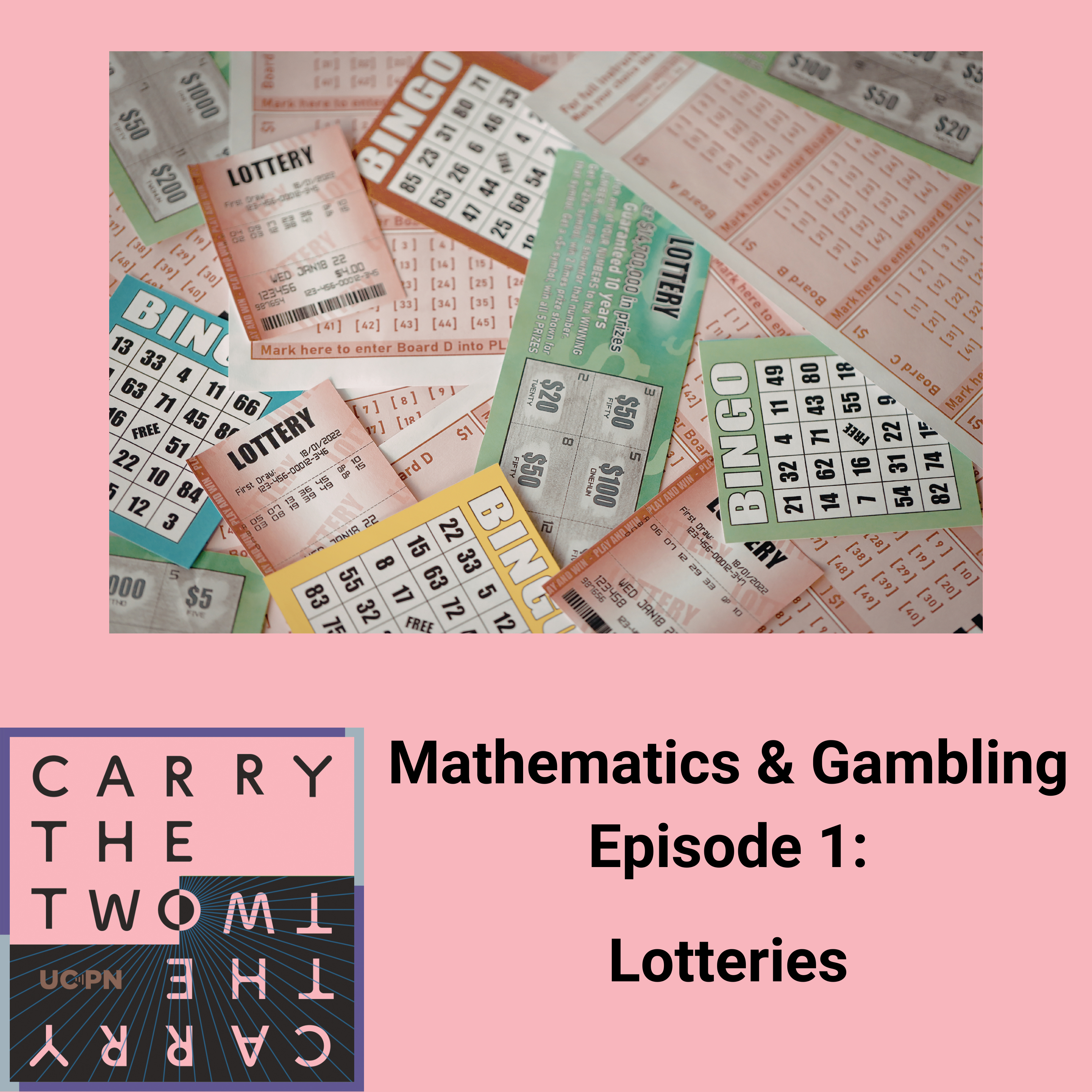
SH: Ok, now we have outfitted ourselves with expected value it’s time for us to truly start our journey. And for this first leg our destination is lotteries.
SW: Oooo like powerball or mega millions?
SH: Those are both great examples, in fact the Powerball jackpot was nearing $1.5 Billion when I spoke with David so it’s exactly where we started
DT: The Powerball that we talked about tomorrow night, there are many different ways to win and there are different payouts that you can get. But invariably you're paying $2 for a single ticket and most of the time you're going to lose. So in our expected value calculation at the very end there's going to be a negative two times the probability you don't win.
SW: Sure, but there are also a lot of possible ways to win as well that have to go into the expected value right?
SH: You are very right, the expected value calculation for the powerball has a lot of different terms
DT: What's the probability you get the Powerball and nothing else times $4. What's the probability you get three white balls and nothing else, $4. And the whole way up to what's the probability you get the Powerball and each of the five other numbers correct times the jackpot, $1.5 billion.
SW: Ok, so that is a lot
SH: Yeah I know, and we’re not even going to touch the possibility of multiple people having the same winning ticket, but here is where an interesting thing with jackpot style games like the powerball comes into play. Most of the payouts in the expected value calculation are fixed, but since the jackpot isn’t fixed the expected value of a powerball ticket changes.
SW: Oh, and is there a time when the expected value of a ticket actually goes above 0.
SH: Well we know that the expected value not including the jackpot term can not be less than negative $2, as that is the cost of the ticket. So, not even considering the rest of the possible ways of winning money if the jackpot times the probability of hitting it is $2 or more then the expected value of a powerball ticket will definitely be positive. So for example with the $1.5 Billion drawing
DT: Powerball generally, I think the chance in getting everything correct is about one in 300 million. So, you know, sure, neither of us expects to win. People have not won over the last couple drawings they had where the amounts were still high. But, you know, you take that 1.5 billion and multiply by, you know, one over 300 million. That's the first piece of your expected value calculation. And the fun thing is, at least we can even do this now live, you know, that's a very easy speculation of you get five.
SW: And 5 plus -2 is 3, so the expected value of a ticket for those drawings was greater than $3. Why weren’t mathematicians out there buying up all the tickets?
SH: Here is where expected values can be a bit tricky. They’re essentially an average over the whole game. Meaning, it is not so much that any given ticket is worth more than $3 as it is that if you added it all of the winnings from all of the players who bought tickets for that drawing and then split the total winnings across all of the players they would then get more than $3 per ticket they bought. Or in other words you would need to buy every single possible ticket in order to achieve this expected value
SW: Oh shoot, that isn’t nearly as much fun.
SH: I know, I even asked David if there were ways around it
DT: And there are strategies. I mean, there's some rich lottery strategies of trying to buy multiple
tickets and controlling how much overlap you have in your tickets so you can get a larger base and have a larger chance of paying out. But I mean, when you're talking about 300 million different possible tickets, I think if you tried to do the math, there aren't enough seconds between drawings if you played one per second to even buy them all.
SH: Big national drawings are not the only type of lottery around though
DT: Some people love scratching them off. Some people scratch for that barcode you can now scan and see if you win. The thing about scratch offs are they usually have a a lower jackpot or a lower maximum prize
SW: Scratchers of course, the classic stocking stuffer. How do those look mathematically?
SH: They are much more controlled than the drawings
DT: The state is deciding we're going to print a certain number of tickets we want to have a certain number of winners and we're going to tell everybody what your chance of winning is and how many tickets of each kind there are.
SW: Which should make calculating their expected value much simpler
SH: 100%, there are no changing jackpot totals or the chance of a jackpot split. The place where it gets interesting with scratch offs is that states will have public websites that track which winning tickets have been found. Which means…
DT: If you're really going to play scratchers and want to try to make money, just knowing what's still out there is part of the game.
SH: Though David was very clear that while an individual may end up winning money from a scratcher, the state, who is playing the role of the house, or the casino, will end up ahead
DT: There is no way you’re going to lose money if you literally print tickets that give out half of what you're selling them for
SW: But haven’t I heard of cases where people have figured out a system to win?
SH: Those cases do happen, it’s often referred to as breaking the game because it means players have found a flaw in the game itself
DT: When you get to a place where you're designing a game, there are ways to break them. And I think they're usually a design failure aspect of these.
SW: What does David mean by design failure?
SH: Well it could be setting the price of a ticket so that the expected value is positive for a player instead of negative or incorrectly calculating the odds or even code that accidentally prints too many winning tickets. Not that these happen often
SW: And I assume once they’re identified, I’m betting that states close those games quickly?
SH: That is probably the highest probability bet we mentioned today
SW: Laughs
(outro music)
SH: If you or someone you know is struggling with a gambling problem, help is available. The National Council on Problem Gambling provides a range of resources, including the National Problem Gambling Helpline™ (1-800-MY-RESET) to help connect you with local resources.
SH: Don’t forget to check out our show notes in the podcast description for more about David’s work and a link to his book and make sure to come back for our next episode in this season which will be all about Casino games
SW: And if you like the show, give us a review on apple podcast or spotify or wherever you listen. By rating and reviewing the show, you really help us spread the word about Carry the Two so that other listeners can discover us.
SH: And for more on the math research being shared at IMSI, be sure to check us out online at our homepage: IMSI dot institute. We’re also on Bluesky at IMSI dot institute, as well as instagram at IMSI dot institute! That’s IMSI, spelled I M S I.
SW: And do you have a burning math question? Maybe you have an idea for a story on how mathematics and statistics connect with the world around us. Send us an email with your idea!
SH: You can send your feedback, ideas, and more to sam AT IMSI dot institute. That’s S A M at I M S I dot institute.
SW: We’d also like to thank Blue Dot Sessions for the music we use in Carry the Two.
SH: Lastly, Carry the Two is made possible by the Institute for Mathematical and Statistical Innovation, located on the gorgeous campus of the University of Chicago. We are supported by the US National Science Foundation and the University of Chicago.
SW: Hahahah
SH: They are a much (raspberry noise)
SW: Hahaha This is my millennial slop bowl leave me alone
SH: Sorry…burping
SW: No, hahaha
SH: Vocalizing